
- Date
- Saturday, 4 July 2026
- Time
- 10:00 – 12:00 WIB
- Venue
- Online via Zoom
- Participants from Aceh, East Java, East Kalimantan, North Maluku, West Sulawesi, and Papua
- Program
- Skill Our Future: EdTech Impact Bootcamp 2026 — Component 2: Digital Transformation for EdTech Startups
- Yayasan Kita Bisa (Kitabisa) × UNDP Indonesia
- Session
- AI Tools Proficiency for Founders
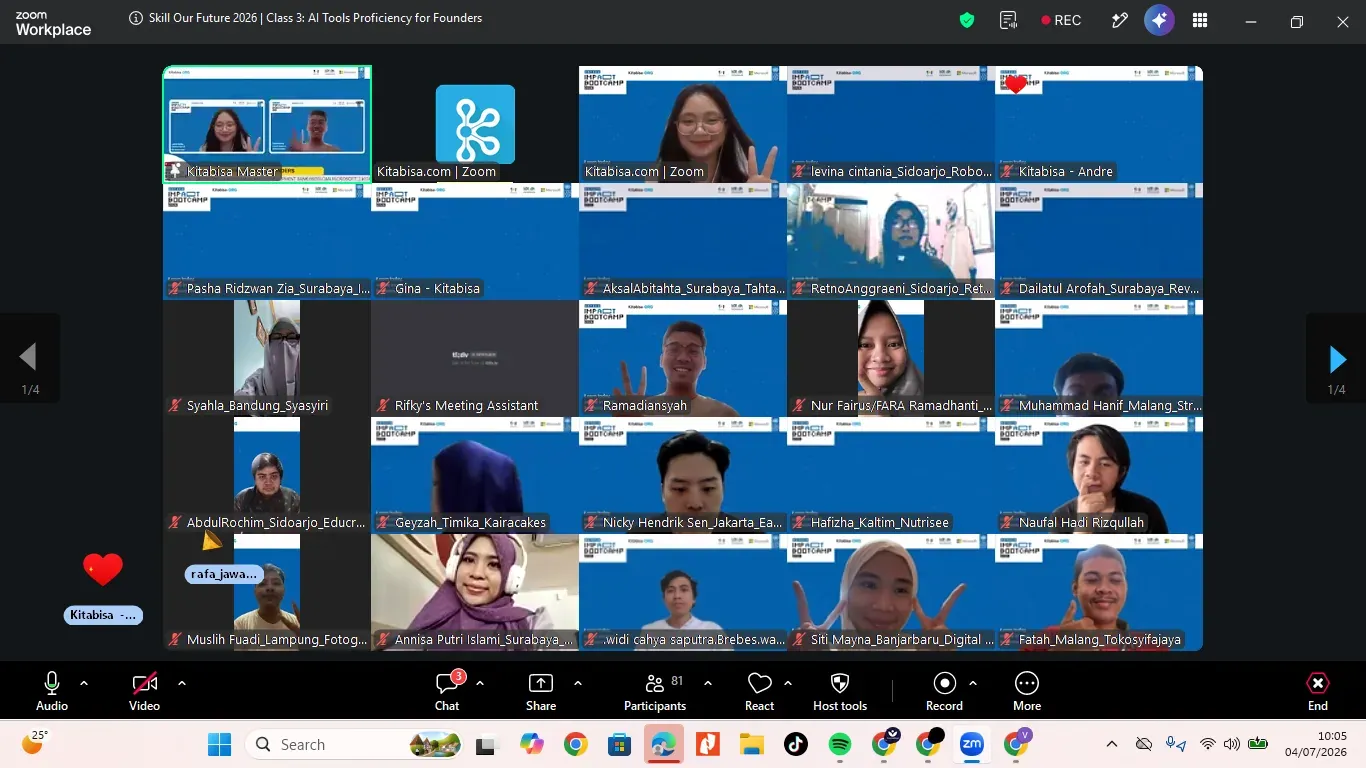
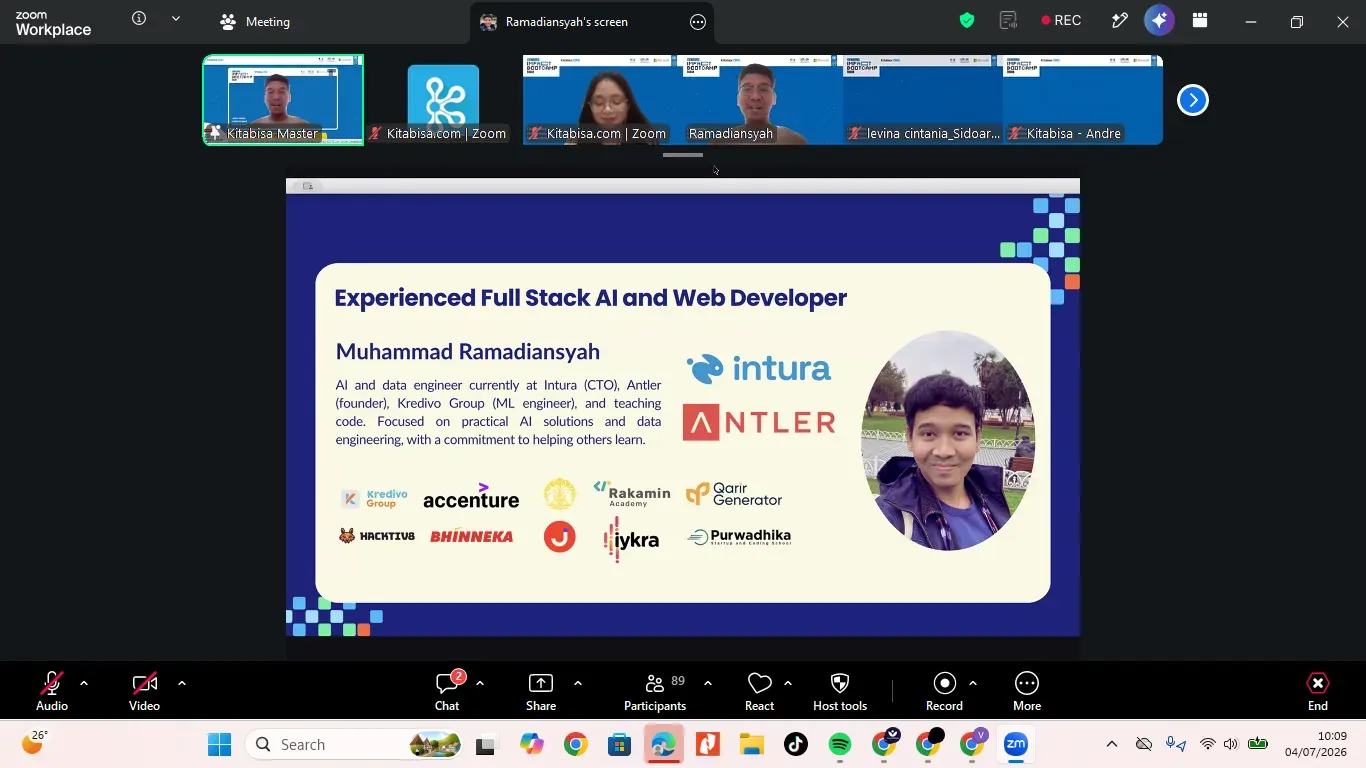
Jakarta, 4 July 2026 — On a Saturday morning, around 200 young founders logged into a Zoom room from six corners of Indonesia: Aceh, East Java, East Kalimantan, North Maluku, West Sulawesi, and Papua. They came for a two-hour session titled "AI Tools Proficiency for Founders", part of the Skill Our Future: EdTech Impact Bootcamp 2026 organised by Yayasan Kita Bisa with UNDP Indonesia. The speaker: Muhammad Ramadiansyah, Co-Founder and CTO of Intura. The promise of the session was captured in its subtitle — from using AI to building AI workflows.
Key Highlights
200 Founders, 6 Regions
Around 200 youth entrepreneurs (age 17–30) leading early-stage EdTech social enterprises joined from Aceh, East Java, East Kalimantan, North Maluku, West Sulawesi, and Papua
From Using AI to Building Workflows
The session traced the shift from prompt engineering (2024) to context engineering (2025) to harness and loop engineering (2026) — with live examples for each stage
Hands-On with Gemini Gems
Participants built their own custom AI assistant live — defining its role, uploading brand guidelines and product knowledge, and testing it against real questions
Responsible AI in Practice
A dedicated ethics segment covered AI slop, hallucination and verification habits, and data privacy — including how to redact sensitive data before it ever reaches a chat window
A Bootcamp Built on a Demographic Bet
The numbers behind the programme explain its urgency. According to Statistics Indonesia (BPS) 2024, Indonesia is home to 65.82 million young people aged 16–30 — 24% of the total population. That demographic bonus sits at the centre of the Indonesia Emas 2045 vision. Yet roughly 23.78% of Indonesian youth are classified as NEET — not in education, employment, or training — and with the country's digital economy projected to reach $133 billion by 2025, the gap between digital opportunity and digital skills is widening exactly where it hurts most.
The Skill Our Future: EdTech Impact Bootcamp 2026 is Kitabisa and UNDP Indonesia's answer to that gap: an incubation programme for youth-led social enterprises in the education sector, all at minimum viable product stage or beyond, all working directly or indirectly on the Sustainable Development Goals. This session belonged to Component 2 of the programme — Digital Transformation for EdTech Startups.
The terms of the engagement set a bar that shaped the whole design of the session: at least 60% of the two hours had to be hands-on activities, live demonstrations, and participant exercises. Not a lecture with a demo at the end — a working session, delivered in Bahasa Indonesia.
Reading the Room Before Teaching It
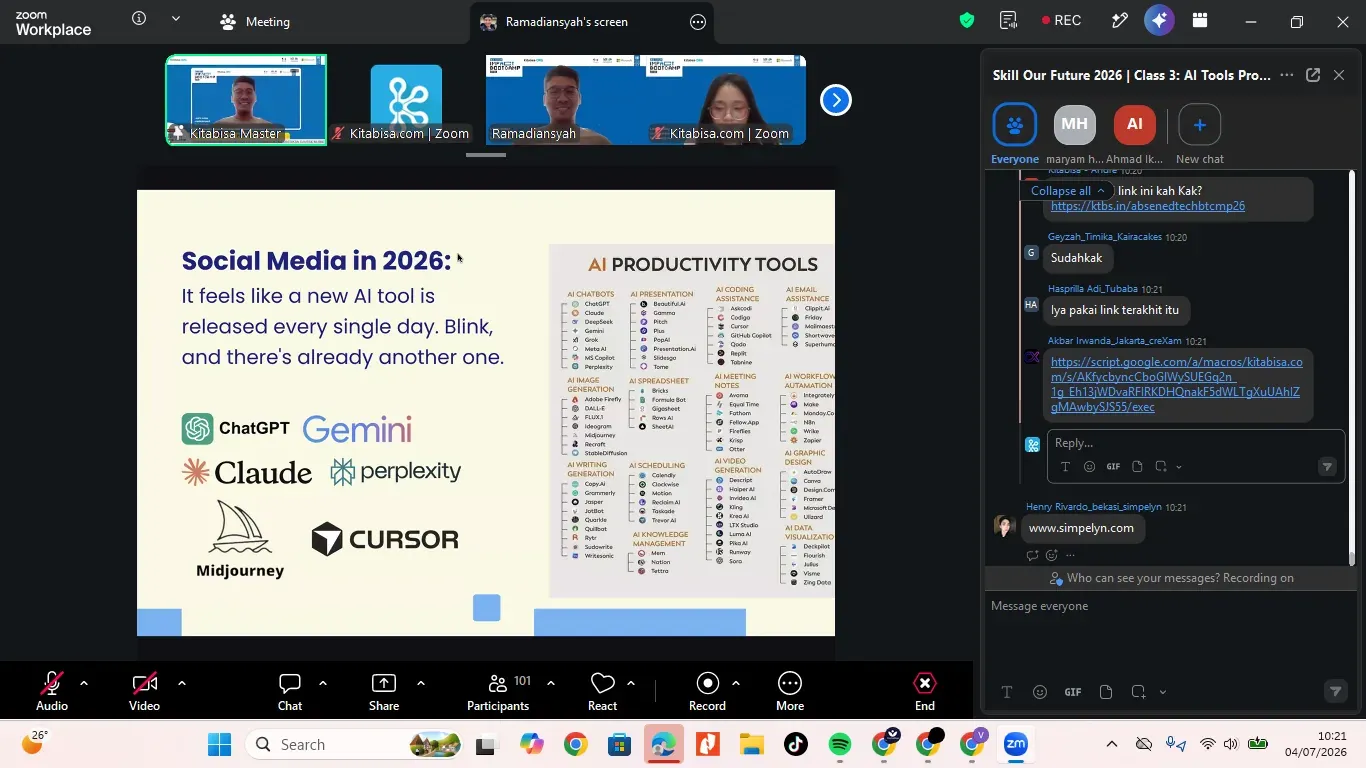
The session opened with a game, not a definition. Participants were shown pairs of images — A or B — and asked two questions: which one do you prefer, and do you think it was AI-generated or human-made? The point landed quickly. Most people can no longer reliably tell, and in 2026 it feels like a new AI tool ships every single day. Blink, and there's already another one.
From there, the session mapped the practical AI tool categories a founder actually needs: design (visuals, presentations, UI mockups, marketing assets), coding (building applications and automating development), productivity (content, task management, daily operations), and research (market analysis, summarisation, insight generation). Real names throughout — ChatGPT, Gemini, Claude, Perplexity, Midjourney, Cursor — because the founders in the room are choosing between real subscriptions, not abstractions.
Before touching a single prompt, Muhammad grounded the room in how these systems actually work: models are trained on massive data, every model has a knowledge cutoff, and most AI products are built on top of existing models like GPT, Gemini, Claude, or Llama — enhanced with custom data, workflows, and business logic. The anatomy of an AI product, he explained, comes down to three ingredients: instructions, context, and tools. And with that anatomy come four limits every founder must respect: hallucination, the knowledge cutoff, context dependency, and bias.
From Prompt Engineer to Loop Engineer
The core of the session was an evolution story. Working with AI in 2024 meant prompt engineering — crafting the text you give a model to get better outputs. 2025 added context engineering — feeding the AI the right knowledge at the right time. And by 2026 the frontier has moved to harness engineering and loop engineering: designing the workflow, controls, and feedback loops around a model so it can evaluate, improve, and retry its own work until the output actually meets the bar. As Muhammad joked to the room: "I was a prompt engineer yesterday, a context engineer today, and a loop engineer tomorrow."
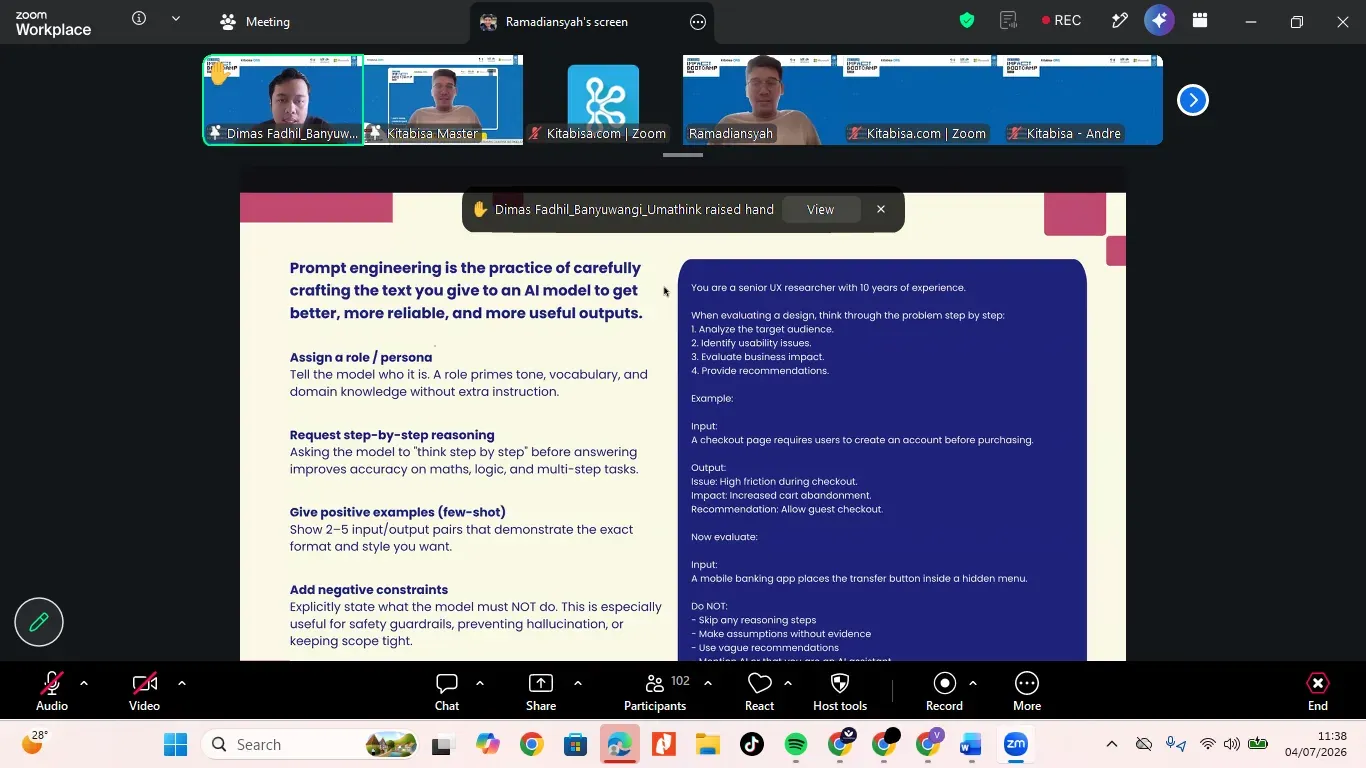
Each stage came with practice, not just slides. The prompt engineering segment demonstrated four techniques live: assigning a role or persona, giving few-shot examples, requesting step-by-step reasoning, and adding negative constraints — the explicit "do NOT" list that keeps outputs on-scope and honest. Participants then opened Google Gemini and built their own custom AI assistant with Gemini Gems: defining its role, tone, and instructions for their own brand or company.
The context engineering exercise went one step further. Participants uploaded their enterprise's actual knowledge — brand guidelines, product documentation, FAQs, SOPs — into their Gem and updated its instructions to use that knowledge. The same prompt, "create a LinkedIn post about why startups should conduct user research before building a product", produces a generic answer without context and an on-brand one with it. For the harness stage, Muhammad showed how a tool like n8n can orchestrate an automated content pipeline — research, planning, carousel generation, quality check — and how a loop closes when the system also monitors social sentiment and measures business performance, feeding the results back in.
The good news: everyone can use AI. The bad news: everyone can use AI. Access to the tools is no longer an advantage — every founder in this room has the same subscriptions. The advantage goes to the founders who build context, workflows, and judgment around the tools.
The Ethics Segment Nobody Skipped
The final teaching block took on the failure modes directly, each framed as a risky habit next to a safe one. First: AI slop — copy-pasting raw AI output into a blog post, report, or donor update without reading it. Published at scale, unreviewed AI content degrades trust in everything an enterprise says. The responsible pattern is simple: AI writes the first draft, the human edits, fact-checks, and adds the expertise that makes the content worth reading.
Second: verification. AI models hallucinate — they generate confident, fluent, wrong answers, from invented case citations to incorrect figures. For social enterprises that report to funders and teach students, treating AI output as ground truth is one of the most consequential mistakes available. The safe habit: treat every AI answer as a starting point, and ask whether the claim can be verified from a primary source.
Third: data privacy. Anything pasted into an AI chat leaves your device and travels to a third-party server. The session gave founders a concrete protocol — redact names and financial figures with placeholders like [CLIENT] before pasting, prefer enterprise or private deployments for sensitive work, read the provider's data retention policy, and be especially careful with regulated data. For enterprises handling student and donor information, this is not an optional courtesy. It is the baseline.
Why Intura Shows Up for Sessions Like This
Intura's own work sits inside the shift this session described: we build AI visibility and brand intelligence tools, and we use AI workflows — not just AI tools — to do it. Teaching 200 EdTech founders how to make that same shift is the most direct way we know to widen who benefits from it. The founders in this cohort are building for classrooms in regions where the digital skills gap is not a statistic but a daily constraint, and every hour saved by a well-built workflow is an hour returned to teaching and building.
The session closed with fifteen minutes of Q&A and action planning, and a line that doubled as a summary and a warning: the good news is that everyone can use AI — and the bad news is that everyone can use AI. What separates founders now is not access. It is proficiency: context, workflow design, and the judgment to know when to trust the output and when to check it.
Our thanks to Yayasan Kita Bisa and UNDP Indonesia for organising the Skill Our Future: EdTech Impact Bootcamp 2026 and for the invitation to contribute to it — and to the 200 founders who showed up on a Saturday morning, built their first custom AI assistant, and asked the kind of questions that only people building real products ask.
Intura builds AI-native brand research and intelligence tools — helping brands understand how they are perceived across AI platforms, social media, and e-commerce, and turning AI workflows into a practical advantage.
Tags
- Kitabisa
- UNDP Indonesia
- EdTech
- AI Tools
- Prompt Engineering
- Youth Entrepreneurs