Intura Returns to Product Hunt as an AI Search Optimization Service
Launch Date
29 July 2026
Position
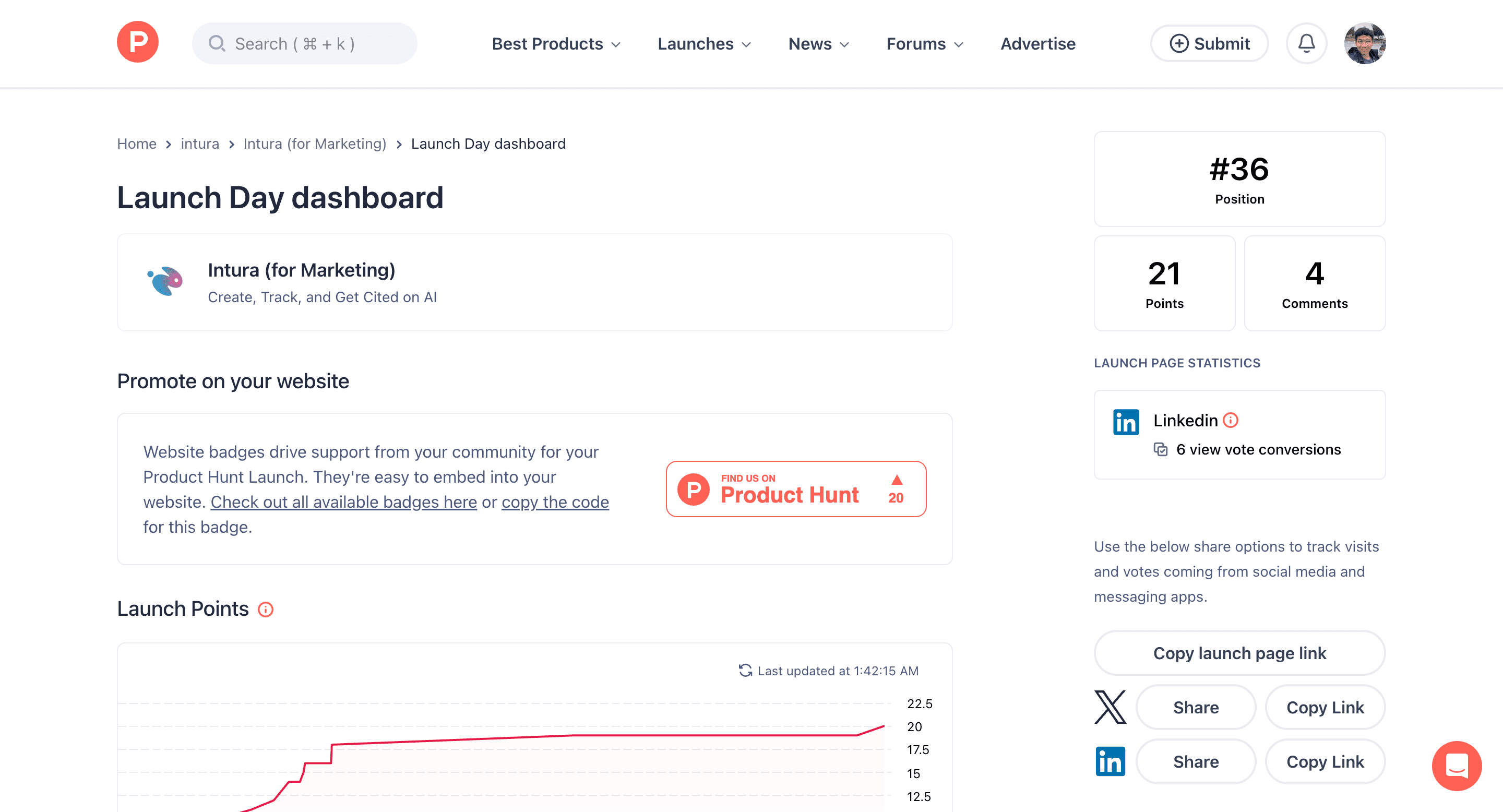
#36 on launch day
Points
21 points
Comments
4 comments
Product
Intura (for Marketing) — “Create, Track, and Get Cited on AI”
Every number below comes from two places: our own Product Hunt launch-day dashboard, captured on 29 July 2026, and the product screenshots we submitted with the listing. Nothing here is estimated.
On 29 July 2026 we launched on Product Hunt for the second time. The listing reads "Intura (for Marketing) — Create, Track, and Get Cited on AI." Sixteen months earlier, the first one read "intura — Compare, test, and optimize AI models." Same company, different product, and a very different audience: the March 2025 launch was aimed at engineers picking between OpenAI and Anthropic; this one is aimed at the marketer who just found out ChatGPT has been describing their company wrong for six months. Launch day finished at #36 with 21 points and 4 comments. That is a smaller number than last time, and the reason is worth writing down.
Key Highlights
New name, new job
The listing is "Intura (for Marketing)", tagline "Create, Track, and Get Cited on AI" — a marketing product, where the March 2025 listing was a developer tool for comparing LLMs.
#36 on launch day
Our launch-day dashboard recorded position #36 with 21 points and 4 comments. Smaller than the first launch, against a completely different audience.
Three surfaces in one workspace
AI Visibility Reports, a prioritised task list built from audit findings, and an AI Assistant that drafts the fixes — the tracking and the doing in one place.
LinkedIn was the only channel that converted
Product Hunt attributed 6 view-to-vote conversions to LinkedIn on launch day, and none to any other channel. They came from a supporter's post that drew 143 reactions — about one vote per 24 reactions.
What did we actually launch?
Intura (for Marketing) is an AI search optimization service that tracks how ChatGPT, Gemini, Claude, and Perplexity describe a brand, then generates the content work needed to fix what they get wrong. The tagline we shipped it under — "Create, Track, and Get Cited on AI" — is the whole product in six words, in the order you use it backwards: you want the citation, so you track the gap, so you create the content.
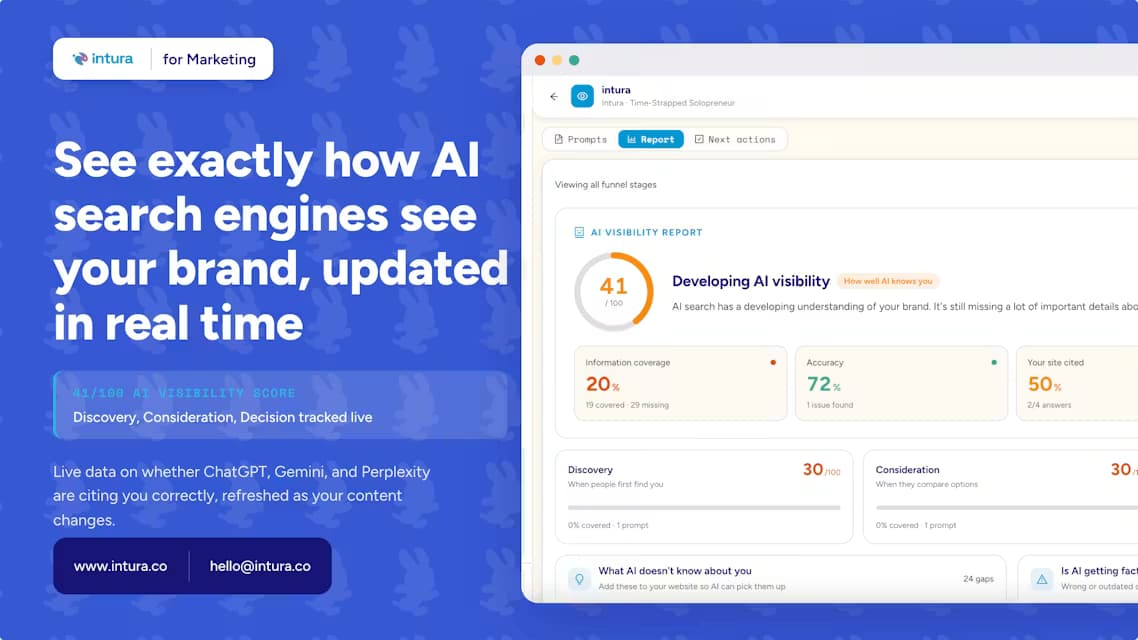
Three surfaces went out with the launch, and each one is a screenshot in this article. The first is the AI Visibility Report: a score out of 100 broken into information coverage, accuracy, and citation rate, evaluated across the funnel stages where a buyer actually meets your brand — Discovery, Consideration, Decision. The sample report in our launch banner scores 41/100, which the product labels "developing AI visibility" — 20% information coverage with 19 topics covered and 29 missing, 72% accuracy with one issue flagged, and the site cited in 2 of 4 answers.
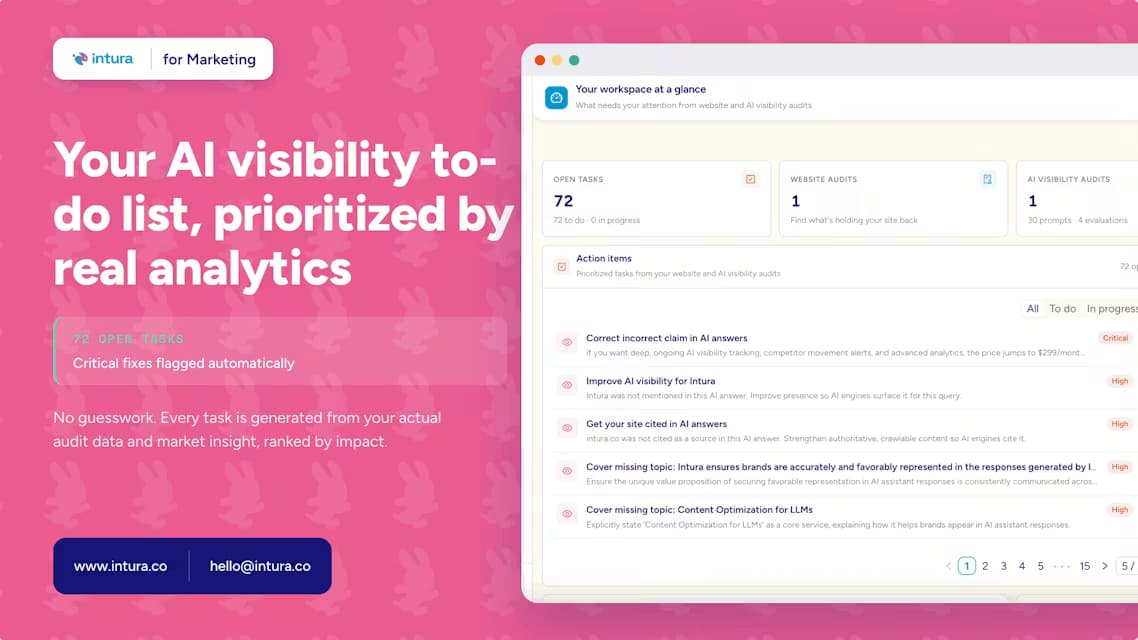
The second surface is the part we care most about. Every audit finding becomes a task. The workspace in our launch screenshot holds 72 open tasks generated from one website audit and one AI visibility audit that ran 30 prompts across 4 evaluations — each task ranked Critical or High, each naming a specific thing to do: correct an incorrect claim in AI answers, cover a topic AI never mentions, get a page cited where a competitor is cited instead.
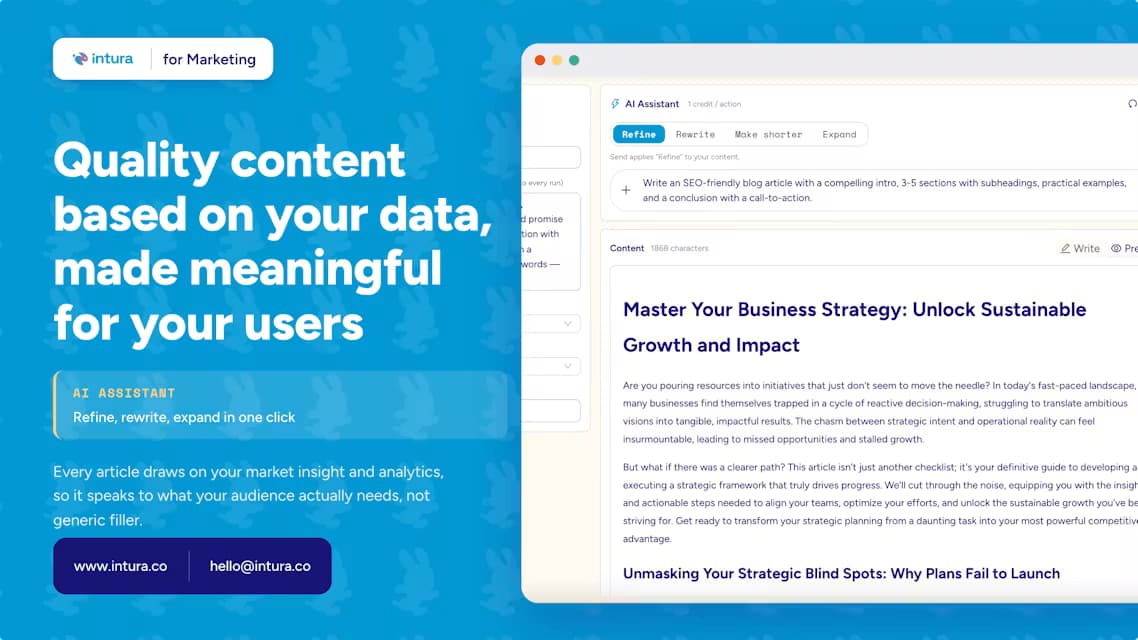
The third is the AI Assistant, which drafts the content those tasks ask for. Refine, Rewrite, Make shorter, Expand — one credit per action, working from your own audit data and brand guidelines rather than a blank prompt box.
Knowing your brand is invisible to ChatGPT is not the same as knowing what to write on Tuesday morning. The gap between the dashboard and the work is where most AI visibility tools stop — and it is the gap this launch was built to close.
Why relaunch instead of shipping an update?
Because the buyer changed, and Product Hunt listings are indexed by who they speak to. The 2025 product solved a problem engineers have. The 2026 product solves a problem marketing teams have. Running that under the old listing would have put a marketing tool in front of an audience who came for a model-comparison dashboard, and the tagline would have been a lie by omission.
The through-line is real, though, and it is the reason this is the same company rather than a pivot. Evaluating how a language model responds to a prompt — at scale, repeatedly, with the results stored and compared — is the same machinery whether you are asking "which model is cheapest for this task" or "what does Gemini say when someone asks for the best CRM in Indonesia." We built the second product on the first one's bones.
What changed is what we do with the answer. In 2025 the output was a comparison table. In 2026 it is a work queue.
How did launch day actually go?
We finished #36 with 21 points and 4 comments, against #9 with 168 upvotes and 152 followers in March 2025. Product Hunt attributed 6 view-to-vote conversions to LinkedIn; no other channel registered any.
The honest read: we launched into a category — AI visibility tooling — that got crowded fast, and we did it without the coordinated push we ran the first time. Our first launch had a maker community behind it that we had spent weeks warming up. This one went out on a Wednesday with a product that was ready and almost nothing scheduled behind it.
We are publishing the number rather than the adjective because a launch metric is a marketing input, not a product verdict. The four comments were from people running actual brands who wanted to know how the citation rate is measured — which is a better signal about product-market fit than a hundred upvotes from makers who will never open the dashboard again. Our read: for a tool this specific, the leaderboard was never going to be the channel that matters.
How did anyone find out about the launch?
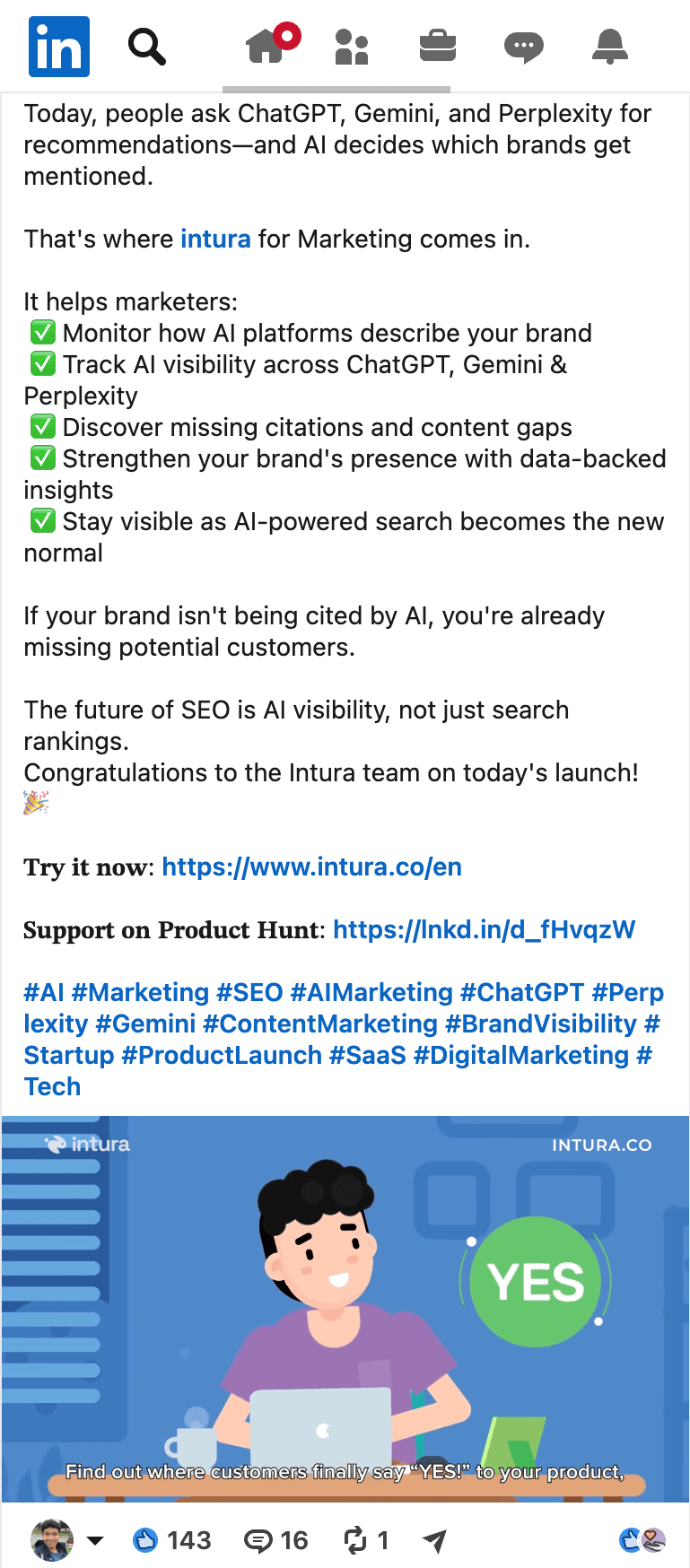
Almost entirely through one LinkedIn post, and we did not write it. A supporter published it on launch day — a plain description of what the platform does for marketers, a link to intura.co, a link to the Product Hunt page — and it reached 143 reactions, 16 comments, and 1 repost when we read the counts on 31 July 2026. Product Hunt attributed 6 view-to-vote conversions to LinkedIn. Every other channel we could have used sat idle.
Line those two numbers up and you get the least comfortable fact of the launch: 143 reactions produced 6 votes, roughly one vote for every twenty-four people who tapped a reaction. Between liking a post and casting a vote sits a click-through, a Product Hunt account, and a reason to care about a leaderboard — and most people stop at the first step. Reach is not distribution. It is the cheapest part of it.
The part worth keeping is the comment thread. Sixteen comments on a post about AI visibility, from people who work in marketing rather than people who collect launches, told us more about who this product is for than the ranking did. That is the audience we built the second version for, and it turned out to be reachable through exactly one channel — which is a distribution problem, not a product one.
What does the platform look like in practice?
The one-minute overview below is the clearest answer. We published it on 5 March 2026, before this launch, and it is the video we point people to when they ask what "AI visibility" concretely means: the shift from customers scrolling links to customers asking GPT, Gemini, and Claude for a direct recommendation — and what it costs a brand to be absent from that answer.
What this launch does not tell you
A Product Hunt result measures launch-day attention from the Product Hunt audience on one particular day. It says nothing about retention, nothing about whether the AI Visibility Report correlates with revenue, and nothing about how the product performs outside the English-language prompt sets most of our early evaluations ran on.
The scores in the screenshots are from a sample workspace we used for launch assets, not a customer account — treat them as an illustration of the report format, not as a benchmark. We also have not yet published a methodology page explaining how the citation rate is calculated across engines, which is the question the launch-day commenters asked and the one we owe an answer to.
Disclosure: Intura sells AI search optimization software, which is the category this article describes. Read it with that in mind.
What happens next?
The work queue is where we are putting our effort. Tracking is table stakes now — a dozen tools will tell you your brand is invisible in AI answers. Far fewer will tell you which of the 72 things to fix first, and fewer still will draft it.
Thank you to everyone who upvoted, commented, or asked a hard question on launch day. The hard questions were the useful part.
Intura is an AI search optimization service. It tracks how AI search engines describe your brand, finds the gaps, and turns them into content work you can actually ship.
Explore InturaFrequently Asked Questions
What did Intura launch on Product Hunt in July 2026?
Intura launched "Intura (for Marketing)" on Product Hunt on 29 July 2026, under the tagline "Create, Track, and Get Cited on AI." It is an AI search optimization service that tracks how ChatGPT, Gemini, Claude, and Perplexity describe a brand, turns the gaps into a prioritised task list, and drafts the content needed to close them.
How did Intura rank on Product Hunt?
Intura (for Marketing) finished at position #36 on its launch day, 29 July 2026, with 21 points and 4 comments, according to our own Product Hunt launch-day dashboard. Intura's first launch in March 2025 finished #9 Product of the Day with 168 upvotes and 152 followers.
How is this different from Intura's first Product Hunt launch?
The March 2025 launch was a developer tool for comparing, testing, and optimising LLMs — aimed at engineers choosing between models. The July 2026 launch is a marketing platform aimed at brand and content teams, built on the same evaluation machinery but pointed at a different question: what AI search engines say about your brand, and what to publish about it.
What is inside an Intura AI Visibility Report?
The report gives a brand an AI visibility score out of 100, broken into information coverage, accuracy, and citation rate, and evaluated across the Discovery, Consideration, and Decision funnel stages. The sample report shown in the launch assets scores 41/100 with 20% information coverage, 72% accuracy, and the site cited in 2 of 4 AI answers.
How was the July 2026 launch promoted?
Through one LinkedIn post, written by a supporter rather than by Intura, that reached 143 reactions, 16 comments, and 1 repost as read on 31 July 2026. Product Hunt attributed 6 view-to-vote conversions to LinkedIn on launch day and none to any other channel — roughly one vote per 24 reactions on the post.
Sources
- Product Hunt — Intura product page and launch-day dashboard (29 July 2026)
- Intura (YouTube) — "Meet Intura: The AI Visibility Platform for the Future of Search & Social", published 5 March 2026
- LinkedIn — public post announcing the launch and linking to Product Hunt; engagement counts read on 31 July 2026